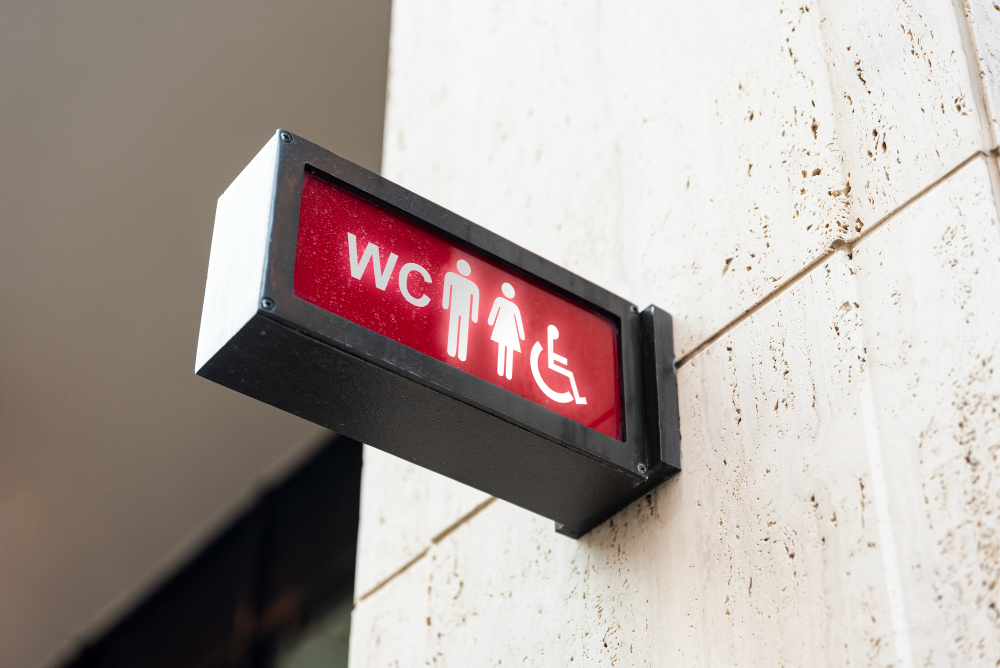
Separate male and female washrooms are now the default expectation across most UK settings, backed by four overlapping sources: Building Regulations in England, the Equality Act 2010 as clarified by the Supreme Court, the EHRC’s statutory services Code, and long-standing workplace and school premises rules.
The position has moved quickly since 2024. A new Part T of the Building Regulations took effect in October 2024, the Supreme Court ruled on the meaning of “sex” in April 2025, and the EHRC’s updated Services Code came into force on 5 August 2026.
We’ve set out what each source says and what it means for anyone planning, specifying or refurbishing washrooms.
Building Regulations: Approved Document T
In England, new buildings other than dwellings and schools must now provide single sex toilets as the default. The Building (Amendment) (England) Regulations 2024 added a new Part T (Toilet Accommodation) to the Building Regulations 2010, supported by Approved Document T. Both came into force on 1 October 2024 and were subject to transitional provisions. Provisions under Approved Document T don’t apply to schools.
Requirement T1 asks for reasonable provision of male and female single-sex toilets. Where space precludes that, universal toilets should be provided instead. Universal toilets may also be added alongside single-sex provision where space allows.
The Regulations define a single-sex toilet as facilities intended for the exclusive use of one sex, with washbasins and hand-drying either in the cubicle or in a separate area used only by that sex. A universal toilet is a fully enclosed room with its own washbasin and hand-drying, for individual use by anyone.
Approved Document T sets out four types of toilet accommodation:
Type | Description | Use |
A | Fully enclosed, self-contained ambulant universal toilet | Universal |
B | Fully enclosed, self-contained universal toilet | Universal |
C | Ambulant single-sex toilet cubicle (not self-contained) | Single-sex |
D | Single-sex toilet cubicle (not self-contained) | Single-sex |
Types A and B can also form part of single-sex provision where self-contained rooms are preferred to cubicles. A universal toilet is not the same as the wheelchair-accessible unisex toilet required under Approved Document M, which remains a separate requirement.
Three further points matter on site. Part T does not set the number of toilets, that sits with Approved Document G. Part T is aimed at new non-domestic buildings and material changes of use, whether a washroom refurbishment brings it into play depends on the scope of work, so confirm with building control early. Approved Document T was revised on 3 November 2025 to correct minor errors, including adding a visual contrast requirement to the Type D equipment table, so specifiers should check they are working from the current edition.
The Supreme Court Ruling and the Equality Act 2010
On 16 April 2025 the UK Supreme Court ruled in For Women Scotland v Scottish Ministers that “sex” in the Equality Act 2010 means biological sex, and that “woman” means a biological woman.
The ruling matters for washrooms because the Act’s single-sex and separate-sex service exceptions depend on that definition. Under the Act, a provider can lawfully run a service for one sex only if it is a proportionate means of achieving a legitimate aim and one of the statutory conditions applies.
The judgment itself did not change any building standard or product requirement. It changed how existing law is read, which is why the EHRC’s updated guidance that followed is the practical reference point for service providers.
The EHRC services Code of Practice
The EHRC’s updated Code of Practice for services, public functions and associations came into force on 5 August 2026, replacing the 2011 Code. It was laid before Parliament on 21 May 2026 and completed the parliamentary process without being disapproved. It covers England, Scotland and Wales.
The Code does not create new legal duties. It explains existing law, and courts and tribunals must take relevant parts of it into account, so it’s the benchmark an organisation’s washroom policy is likely to be judged against.
On toilets, the Code’s key points as are:
- Single-sex services must be based on biological sex. A provider that admits people of the opposite sex to a single-sex facility may lose the protection of the single-sex exceptions.
- Providers must be able to show that separate or single-sex provision is proportionate, weighing any disadvantage to trans people and others against the aim pursued.
- Trans people must still have access to essential services such as toilets. The Code encourages mixed-sex options, such as lockable self-contained or accessible toilets, alongside single-sex provision.
- It is good practice to document why a particular arrangement was chosen, with supporting evidence.
The EHRC has said updated guidance for employers will follow.
Workplaces: the 1992 Regulations
Employers have had a single-sex duty for over 30 years. Regulation 20 of the Workplace (Health, Safety and Welfare) Regulations 1992 requires separate rooms containing toilets for men and women, except where each toilet is in its own room with a door that can be secured from inside.
The exception is for a separate lockable room, not a cubicle within a shared space. Mixed-sex cubicles opening onto a shared washbasin area are widely read as falling outside it.
Related rules cover washing facilities (regulation 21) and changing facilities (regulation 24). Where only hands, forearms and face are washed, regulation 21 allows washing facilities to be shared between men and women, this flexibility does not carry over to new buildings designed under Part T. Shower rooms may be mixed-sex only where each is for one person at a time and lockable from inside, changing must be separate, or used separately, where propriety requires. The Health and Safety Executive enforces these Regulations.
Schools and Education settings
Schools in England must provide separate toilets for boys and girls aged 8 and over. Regulation 4 of the School Premises (England) Regulations 2012 allows one exception: a room that can be secured from inside and is intended for one pupil at a time. Changing rooms and showers are required for pupils aged 11 and over who take PE.
The English regulations do not explicitly state that shared washbasin areas are prohibited. They also separately refer to “toilet facilities” and “washing facilities”, which is different wording from the Scottish regulations referenced below.
In Wales, the Education (School Premises) Regulations 1999 require washrooms for pupils aged 8 and over to be separate for male and female pupils.
A Scottish case shows how strictly courts may read these rules. In DE and FG v West Lothian Council (judgment published June 2026), a new primary school had single-sex cubicles but shared washbasins. The court held that “sanitary accommodation” covered the whole toileting area, including washbasins, so the layout breached the Scottish regulations and indirectly discriminated against girls.
The Department for Education has also published draft guidance on children questioning their gender, which says schools must not let pupils over 8 use toilets for the opposite biological sex.
For education projects, the practical lesson is that washbasins matter as much as cubicles. A universal option should have its own basin inside a fully lockable room.
Wales, Scotland and Northern Ireland
Building regulation is devolved, so Part T and Approved Document T apply to building work in England only. Projects in Wales and Scotland follow their own building regulations and standards, so designers should check the current local position rather than assume Part T applies.
The Equality Act 2010, the Supreme Court ruling and the EHRC services Code apply across England, Scotland and Wales, as do the 1992 Workplace Regulations. Schools follow the premises rules of each nation.
Source | England | Wales | Scotland |
Part T / Approved Document T | Yes | No | No |
Equality Act 2010 and EHRC services Code | Yes | Yes | Yes |
Workplace Regulations 1992 | Yes | Yes | Yes |
School premises rules | 2012 Regulations | 1999 Regulations | 1967 Regulations |
What this means for washroom design
The guidance points the same way across all four sources: plan single-sex provision first, then add self-contained universal rooms where space allows. For anyone specifying cubicles, that has five practical consequences.
- Washbasins follow the cubicles. Under Part T, a toilet only counts as single-sex if its washbasin and hand-drying are inside the cubicle or in an area used only by that sex, so shared mixed-sex basins or troughs do not work on new builds, however the circulation is arranged. Existing workplaces outside Part T have more flexibility, because the 1992 Regulations allow hand-washing to be shared.
- Universal means fully enclosed. A universal toilet is a self-contained room with its own washbasin and hand-drying, accessed from a circulation space. Floor-to-ceiling cubicles in a shared area are not the same thing.
- Layout and circulation. Under Approved Document T, cubicle doors should open into the single-sex area, and universal, wheelchair-accessible and Changing Places toilets should, where possible, be reached from a main circulation route without passing through single-sex accommodation.
- Accessible provision is separate. Approved Document M’s wheelchair-accessible unisex toilet is still required alongside single-sex and any universal provision.
- Refurbishment programmes. Existing estates with mixed-sex cubicle banks may need reconfiguring to meet the workplace or Equality Act position, even where Part T does not apply.
If you’re unsure what this means for you, get in touch with our team who can talk you through what this means for your next project.