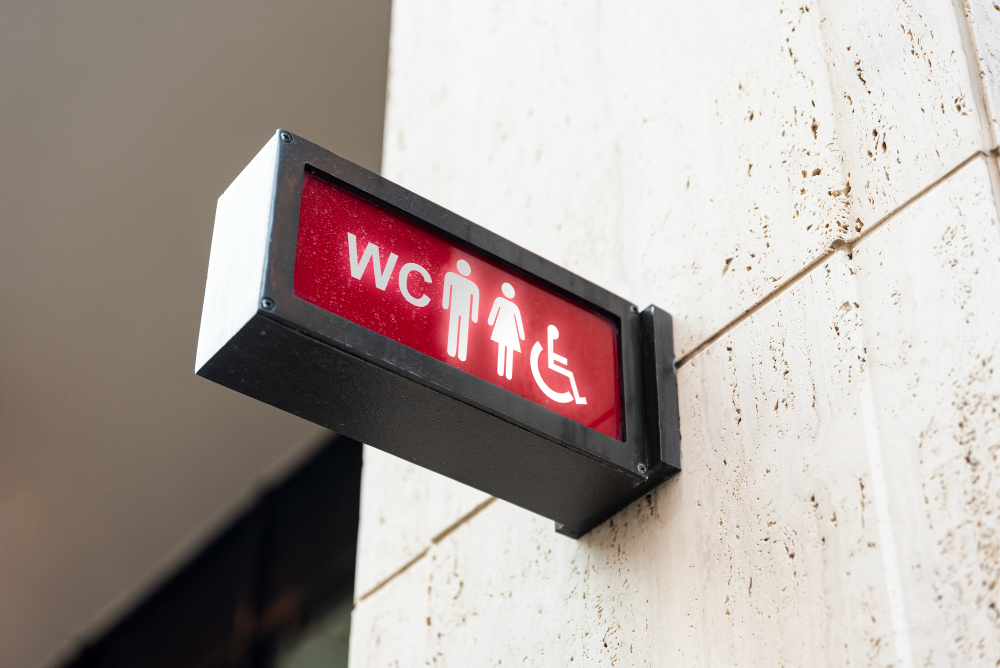
The rules for commercial washroom provision depend on the type of building, whether it’s a new build or a refurbishment, and where in the UK it is. Since 2024, three big changes have landed: Approved Document T, the updated EHRC Code of Practice for service providers, and new safeguarding guidance for schools in England. Each one applies to different buildings.
This guide sets out which rules apply to which buildings, in plain English, so you can brief your project team with confidence. It provides a starting point, not legal advice. Always check the current guidance and confirm your approach with building control and your own advisers.
The rules at a glance
Five sets of rules shape most washroom projects in England. They overlap, so most buildings need to satisfy more than one.
Approved Document T (toilet accommodation). Statutory guidance under the Building Regulations in England. It came into effect on 1 October 2024, with revisions added on 3 November 2025. It applies to new buildings other than dwellings, and to buildings undergoing a material change of use. It sets out four toilet types, including universal toilets, ambulant cubicles and standard single-sex cubicles. Where space doesn’t allow single-sex facilities, fully enclosed universal toilets should be provided. It doesn’t apply to dwellings, schools or early years premises.
Approved Document M, Volume 2 (access to and use of buildings). This remains the main guidance for accessible provision. It covers wheelchair-accessible unisex toilets, Changing Places toilets and baby change facilities. Approved Document T works alongside it, not instead of it.
EHRC Code of Practice for Services, Public Functions and Associations. The updated code came into effect on 5 August 2026, reflecting the Supreme Court’s ruling in For Women Scotland. It applies to organisations providing services to the public. Where single-sex toilets are provided, they should be used on the basis of biological sex, and providers should make additional provision so that trans people are not disadvantaged.
Keeping Children Safe in Education (KCSIE) 2026. Statutory safeguarding guidance for schools in England, in force from 1 September 2026, with new provisions on toilets, changing rooms and showers. Ofsted inspects against it. Read our full guide to KCSIE 2026 for what it means for school buildings.
Workplace (Health, Safety and Welfare) Regulations 1992. These set out employers’ duties to provide suitable toilet and washing facilities for staff. Businesses that make or receive deliveries must also give visiting drivers access to toilets and handwashing facilities.
Quick reference by building type
Use this table as a first check. The Approved Document columns assume a new building or a material change of use in England.
Building type | Approved Document T | Approved Document M | EHRC services code | KCSIE 2026 | Workplace Regulations |
Schools | No | Yes | Education provisions differ | Yes | Yes, for staff |
Retail, leisure and hospitality | Yes | Yes | Yes | No | Yes, for staff |
Transport hubs | Yes | Yes | Yes | No | Yes, for staff |
Offices and commercial | Yes | Yes | Where the public visit | No | Yes, for staff |
Industrial, logistics and manufacturing | Yes | Yes | Where the public visit | No | Yes, for staff and visiting drivers |
MoD sites | Check project requirements | Check project requirements | Check project requirements | No | Check project requirements |
For refurbishments of existing buildings, see the section on new build vs. refurbishment below.
Sector by sector
Schools
Approved Document T does not apply to schools. Instead, school washrooms in England are shaped by KCSIE 2026, the school premises regulations, Approved Document M for accessible provision, and the Workplace Regulations for staff facilities. KCSIE 2026 is the biggest change, and many schools are now reviewing whether their existing toilet blocks can deliver what it asks. Our KCSIE guide covers this in detail.
Retail, leisure and hospitality
Shops, shopping centres, gyms, leisure centres, cinemas and venues are service providers, so the EHRC code applies alongside the Building Regulations. The code’s own example is a shopping centre that offers gender-neutral toilets in individual lockable rooms with handbasins, in addition to single-sex toilets. In practice, many sites need a mix: single-sex cubicles, ambulant and accessible provision, and fully enclosed universal toilets.
Transport hubs
Stations, airports and bus interchanges serve high volumes of the public, so the EHRC code and Building Regulations both apply. Recent station refurbishments show the typical mix: the upgrade at London Waterloo rebalanced male and female capacity, added ambulant toilets for passengers with unseen disabilities, and included accessible toilets with baby change. Many stations are also listed buildings, which adds planning considerations to the programme.
Offices and commercial
For staff, the Workplace Regulations set the core requirements. Where members of the public visit, such as receptions or customer-facing areas, the EHRC services code is also relevant. The EHRC has indicated it may review its separate Code of Practice for Employers, but at the time of writing no consultation or timetable has been announced.
Industrial, logistics and manufacturing
The Workplace Regulations are the starting point for factories, warehouses and distribution centres. One duty is often overlooked: businesses that make or receive deliveries must give visiting drivers access to toilets and handwashing facilities, and refusing access is against the law. Welfare blocks should be planned with drivers, shift patterns and a changing workforce in mind.
MoD sites
Washroom requirements on defence sites are usually set by the project specification and the Defence Infrastructure Organisation (DIO), alongside the wider rules above.
New build vs. refurbishment
Approved Document T applies to new buildings other than dwellings and to buildings undergoing a material change of use. For refurbishments of existing washrooms, whether and how the Building Regulations apply depends on the scope of the work, so confirm the position with building control at the design stage.
The EHRC code, KCSIE and the Workplace Regulations work differently. They govern how facilities are provided and used, so they apply to existing buildings as well as new ones. A refurbishment is often the best opportunity to bring an older washroom in line with current expectations, even where the Building Regulations don’t strictly require it.
Scotland and Wales
The Approved Documents, including Approved Document T, apply in England only. Scotland and Wales have their own building standards and school guidance, so check the local requirements for projects there.
Scotland. Updated Scottish Government guidance says schools must provide separate boys’ and girls’ toilets, with a possible third, gender-neutral option depending on the school community. In Edinburgh, one primary school’s toilets are being renovated and others modified following recent court rulings. The Scottish Government also consulted on updating its school premises regulations, with the consultation closing in March 2026.
Wales. Welsh Government good practice guidance states that regulations require separate toilet areas for male and female learners, and that gender-neutral toilets can be provided alongside single-sex toilets.
Common mix-ups
“A universal toilet is the same as an accessible toilet.” Not quite. A universal toilet under Approved Document T is a fully enclosed, self-contained toilet for individual use by people of either sex. A wheelchair-accessible toilet under Approved Document M is also gender-neutral, but it is a different type of provision with its own requirements.
“Approved Document T replaces Approved Document M.” It doesn’t. The two documents are designed to be applied together.
“Approved Document T applies to schools.” It doesn’t. Schools in England follow KCSIE and the school premises regulations instead.
“A Changing Places toilet is just a larger accessible toilet.” A Changing Places toilet includes specialist equipment such as a hoist, an adult-sized changing bench and space for carers, for people who cannot use standard accessible toilets.
“It’s either single-sex or gender-neutral.” For many buildings, the answer is both. A typical modern layout might combine single-sex cubicles with ambulant and wheelchair-accessible provision, plus one or more fully enclosed universal toilets.
How Dunhams Washrooms can help
If you’re planning a washroom project and want to talk through layout options, get in touch with our team. You can also explore ideas with our Interactive Washroom Visualiser or order colour samples.
Important information
This article is a general overview of the guidance in force as at October 2026. It is not legal or technical advice. Requirements depend on your building, its use and its location, and guidance changes over time. Always refer to the current published documents and confirm your approach with building control and your own advisers.